KODACOLOR 100/200, ISO 400, and the Light Ahead
Load a roll in a park at midday, walk through the shade, then head back to the station in the evening. For a day like that, the sky overhead when you load the camera tells only part of the story. Whether you want to photograph something on the way home changes what the numbers 100, 200, and 400 mean.
KODACOLOR 100 and 200, introduced in autumn 2025, offer a reason to think through that choice. There is 100 for bright conditions, then 200 with another stop of sensitivity. Put 400 beside them, and a question comes before a preference for a particular film: what light will this roll need to last through?
The author has not used KODACOLOR 100/200, and no shooting or processing comparison was carried out for this article. The discussion draws on published specifications and exposure relationships. It is not an evaluation of the new films' colors from personal use.
Two more choices at ISO 100 and 200
PetaPixel reported the introduction of KODACOLOR 100/200 on October 1, 2025. That is the date of international coverage; an official Japanese release date has not been established here. These are not new releases from 2026.
Eastman Kodak's current product pages list both KODACOLOR 100 and KODACOLOR 200 as daylight-balanced color negative films in 135 rolls with 36 exposures. The 135 designation refers to standard 35mm film; it will not load directly into a camera made for 120. Start by checking the format your camera takes.

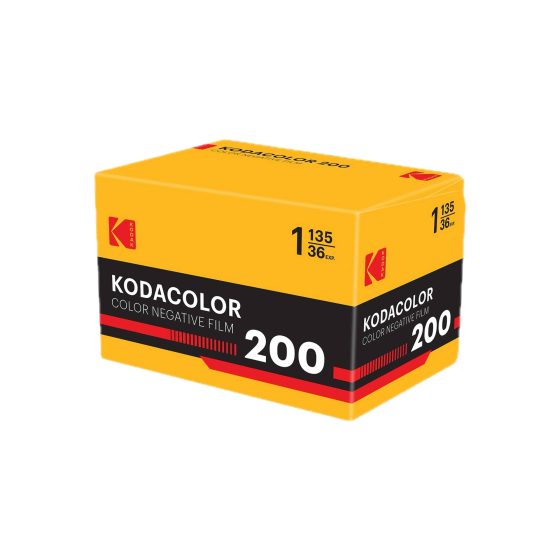
The processing method is C-41. Kodak's product pages did not specify it when checked, so this was verified against retailer Unique Photo's listings for 100 and 200, with matching product numbers. When choosing a lab for the first time, check that it accepts 35mm color negative film for C-41 processing and scanning.
Kodak describes both films in terms of fine grain, saturation, sharpness, and broad exposure latitude. The public information does not, however, establish detailed differences in their rendering. Nor did the primary sources consulted establish whether either shares an emulsion with Gold, ColorPlus, or Pro Image. A new product offering is not enough to establish that a new emulsion has been developed.
The one or two stops that ISO 400 gives you
Shutter speed makes the difference in sensitivity tangible. Double the ISO, and the exposure time needed for correct exposure halves, with light and aperture unchanged. Nikon's explanation of ISO describes this relationship.
Consider a scene with a particular light level, keeping the aperture at f/4.
| Film speed | Example shutter speed for correct exposure | Difference from ISO 100 |
|---|---|---|
| ISO 100 | About 1/60 second | Reference |
| ISO 200 | About 1/125 second | One stop faster |
| ISO 400 | About 1/250 second | Two stops faster |
This is an exposure calculation, not a measurement from a particular location or film test. A stop means doubling or halving the amount of light. Going from 100 to 400 gives two stops; from 200 to 400, one stop. That difference can go toward a shorter exposure.
For someone walking in the shade, 1/250 second leaves more room to stop movement than 1/60. It can help reduce camera shake, too. Or keep the shutter speed the same: where ISO 100 would call for f/2.8, ISO 400 lets you use f/5.6. Those two stops can instead provide more depth of field when you want more of a scene to appear in focus.
This is where 400 gets much of its versatility. Moving from a sunny street into shade is less likely to narrow your options sharply. The UltraMax 400 technical data sheet also identifies low-light performance, handling movement and camera shake, and greater flash range as benefits.
As evening turns to night, that room runs out. Indoors, if the lens is already wide open and the shutter speed is still slow, a moving person can blur even on 400. A tripod holds the camera still; it does not hold the subject still. The lens's maximum aperture, the subject's speed, and whether flash is available all help determine what is possible.
A film camera's ISO dial usually tells the meter what sensitivity to use. Turning it from 100 to 400 partway through a roll does not turn the loaded film into an ISO 400 product. Push processing is not a way to switch sensitivity frame by frame, either: it involves planning exposure together with processing for the roll. Starting at box speed keeps things straightforward. If you want to try pushing, discuss it with the lab before shooting.
When a bright day suits 100 or 200
If you intend to shoot only during daylight, you may not need 400's extra room. In bright light, particularly when you want a wide aperture, 100 or 200 can fit more comfortably within the camera's shutter-speed range.
For example, light that calls for 1/500 second at ISO 100 would call for about 1/2000 at ISO 400 with the same aperture. A camera whose fastest speed is 1/1000 would need another adjustment to give correct exposure while preserving that aperture. Choosing 100 removes the need for a still faster shutter. The difference shows up in operation before any judgment about image quality.
If the subject moves into shade or clouds gather, lower sensitivity asks for a slower shutter or a wider aperture. When loading 100, consider whether you will finish the roll while it is bright, or use flash or a tripod later. At 200, there is one more stop to accommodate that change.
There is no need to assign a personality to each speed: 100 for the careful photographer, 400 for the casual one. Good light allows quick shooting with slower film, and nothing prevents a deliberate composition on 400. Sensitivity sets part of the available exposure range; it does not dictate an attitude to photography.
Choosing a roll for the day
The choices here are for 35mm color negative photography. They are suggestions based on published specifications and shooting conditions, not rankings from a comparative test.
| Film | A roll it could suit | What still needs consideration |
|---|---|---|
| KODACOLOR 100 | Mostly sunny or brightly lit outdoor scenes | Plan what to do when the light falls. Detailed rendering is still something to discover through use |
| KODACOLOR 200 | Mostly bright outdoor scenes, with one stop more room than 100 | Do not infer color differences from 100 or Gold merely from the name or speed |
| Gold 200 | Daytime walks and travel, as a 200-speed film to use repeatedly and get to know | Check whether shade or evening light still allows the shutter speed you need |
| UltraMax 400 | Handheld shooting across sun, overcast skies, and shade, including moving subjects | Dark interiors and night still demand attention to the lens and available flash |
| Portra 400 | People and skin tones, with scanning or enlargements in mind | Compare results under your own conditions rather than treating it as an absolute upgrade over other 400-speed films |
Kodak's Gold 200 description emphasizes vivid color and fine grain; the Portra 400 data sheet emphasizes natural skin tones and suitability for scanning and enlargement. These are manufacturer descriptions, not impressions from our comparative shooting. Gold comes in both 135 and 120, so check the format even when the product name is familiar.
Portra's name also calls for attention to market and date. As checked on September 29, 2026, Kodak Alaris's Japanese site carried a Portra 400 description, while Eastman Kodak's overseas site listed EKTACOLOR PRO. This article uses the Japanese-market name. It does not establish full equivalence between them, a worldwide renaming, or a discontinuation; check the product labeling in the market where you buy.
Even among 400-speed films, ISO tells you about the light required. It does not determine your preferred color or grain on its own. Generalizing across different films that 100 means better quality and 400 means coarse grain will not help make these choices.
Learn the color under consistent conditions
Buying a roll because you like the color of a sample photograph is a natural place to start. But attributing every color in a delivered scan to the film's name can make the next choice confusing. Exposure, processing, the scanner, color correction, and viewing size also affect how color and grain appear.
One way to find a reference is to use the same film several times, with the same lab and scanning instructions. Note what you could photograph on a bright street and in shade, and where a slow shutter became a problem. When trying another film, keeping the light and finishing conditions as similar as possible gives you a basis for comparison. This is a proposed way to discover your preferences, not a test carried out for this article.
There is no need to buy every candidate at once. You might settle on a 200-speed film for daytime walks, then try 400 if shade and evening light often cause problems. Conversely, if 400 often makes you give up a wide aperture in bright light, that is a reason to try 100. Having one thing you want to change each time you add a film makes the next roll easier to choose.
The cost of film together with processing and scanning is discussed in How to Lower the Running Costs of Film Photography. Here, the aim is to find a film you can keep using and understand, rather than compile a list of the lowest prices.
Where do you want to take the last frame?
Someone who finishes a roll in a day faces a different range of light from someone who carries it across several outings. The 36 exposures loaded on a sunny morning may still be in the camera on the next overcast weekend. If there are photographs you want along the way, 400's extra room has a specific purpose.
For a short walk on a bright afternoon, KODACOLOR 100 or 200 could instead be a choice to explore in that light. Lowering sensitivity does not enrich the experience by itself. What matters is whether the film fits the time you want to photograph and the camera you have.
Do you want a frame from the walk home, or a roll of today's bright hours? Think that far ahead before loading, and both 400's versatility and the reasons to choose 100 or 200 become part of your own roll.