When He Could No Longer Ride, the Path Became the Photograph — Arto Saari and "BIKE PATH"
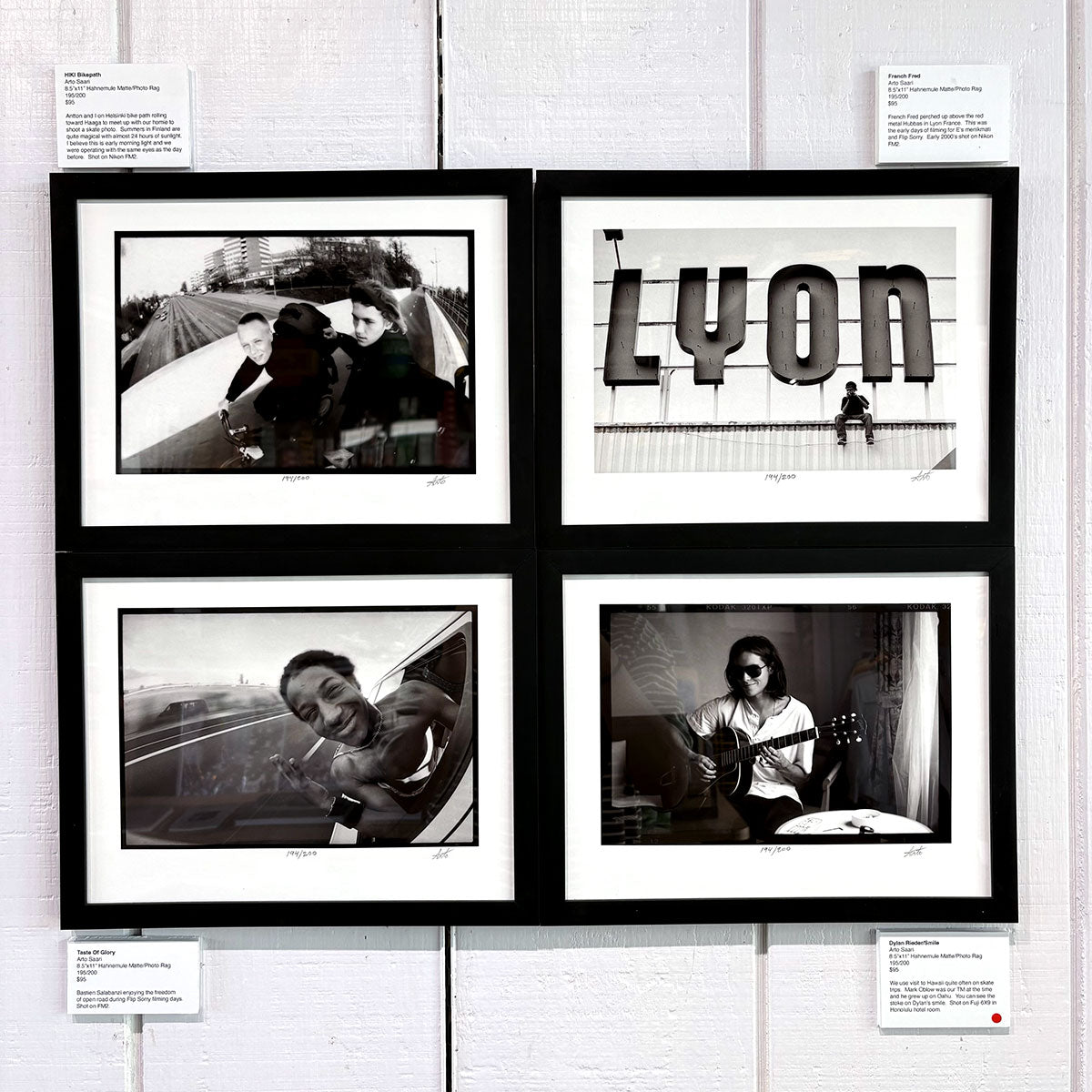
Helsinki, summer 2001. Two young skaters roll down a bike path in early morning light. A camera pointed back at them while they ride bends the frame like a fisheye: two faces, and the road streaming away behind them. The camera is a Nikon FM2. The photograph is credited to Arto Saari, a young Finn who is said to have been named Thrasher's Skater of the Year that same year.
More than twenty years later, he lives on the North Shore of Oahu in Hawaii and has gathered photographs from the island's bike path into a book called BIKE PATH. In 2026 he opened FILM2000Z, a show of film photographs from the 2000s, at a film shop in Honolulu. The trigger, he says, was finding that 2001 frame again at the bottom of a crate.
Saari is usually introduced as a skater who became a photographer. But when you put the photographs side by side, what stands out is continuity more than change. He has always photographed while on the move. What changed was the speed of that movement and the unit of place he works in.
Short answer
The key to Arto Saari's photographs is not his skateboarding or the brand of his camera. It is the route.
As a skater, he photographed on trips that moved from spot to spot. After his body gave out and he could no longer skate, he found himself on the North Shore bike path every day — taking his kids to school, checking the surf, heading out to surf. And on those trips he kept regretting that he did not have a camera with him.
BIKE PATH reads as a book that treats the daily route as a single unit of work. Rather than travelling somewhere special, he passes the same path again and again and gathers the everyday moments and surf action that happen along it. You do not need to be a former pro skater to take that method home.
Premise of this article
The writer has never met Arto Saari and has not seen BIKE PATH in print or visited FILM2000Z. What follows draws on published material: an interview on Leica's official blog, the product page of the publisher SUPER LABO, the print notes from Treehouse Analog Selects, which hosted the show, and a blog post by the Finnish bicycle company Pelago.
Where this piece describes how the photographs look, it stays within what can be read from images on the web. Paper, tonality, and the effect of print size are not judged.
On both sides of the lens
Saari was born in 1981 in Seinäjoki, Finland. In a 2013 interview on the Leica Camera Blog, he traces his first contact with photography to his seventh-grade art teacher, who lent students a 35mm camera and a few rolls of film. They would slip out of class to shoot skateboarding around town.
Later, surrounded by photographers as a pro skater, he became interested again. One of them sold him a camera and gave him a small cheat sheet to learn from. In the statement for the Treehouse show, he describes his early-2000s life as split between trying to land tricks and figuring out how to capture them. He learned by watching, asking too many questions, burning through film, and acquiring cameras along the way.
In those years he stood on both sides of the lens. As a subject, he knew how a trick would look in a picture. As a photographer, he documented his friends' trips from the inside. The print notes for FILM2000Z name the cameras: Nikon FM2, Hasselblad, Rolleiflex, Fuji 6x9. From 35mm to 6x9, he seems to have shot with whatever camera he had at the time.
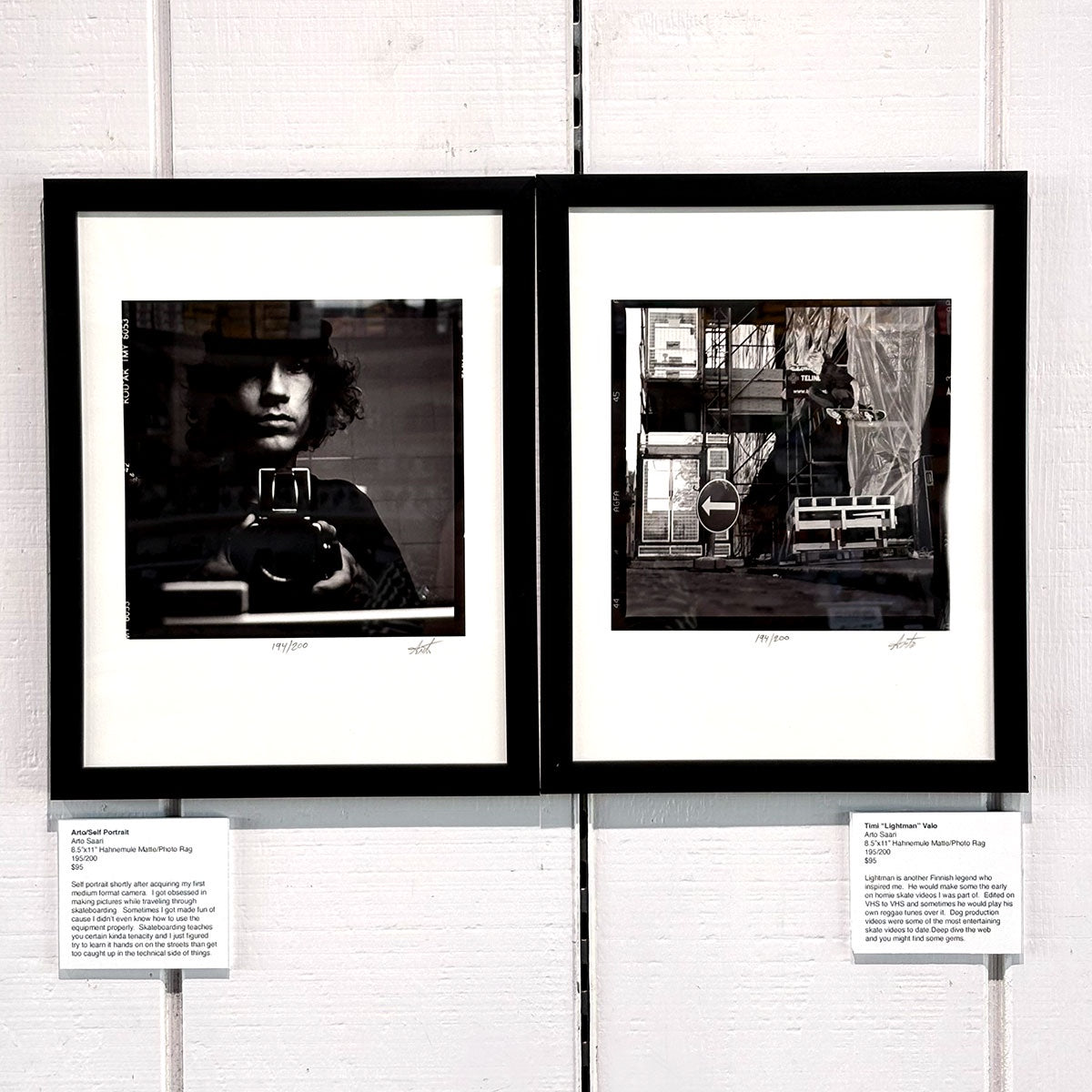
In the note for that self-portrait he writes that he sometimes got made fun of for not knowing how to use the equipment properly. Skateboarding teaches a certain tenacity, though, and he chose to learn hands-on in the streets rather than get caught up in the technical side.
2013: an M7 and two Summarits
By the 2013 interview, his kit had narrowed. A Leica M7 with a Summarit 35mm f/2.5 and a Summarit 50mm f/2.5, and lately he had been shooting mostly with the 50mm. His interest in Leica began with Ed Templeton, a fellow professional skater and photographer.
The reasons he gave for using a Leica were its small size, light weight, and discretion: people relax more in front of it. And what made it right for documenting skate life was that you can have it on you all day and night and it won't weigh you down — it travels easily and you can be quick on the draw.
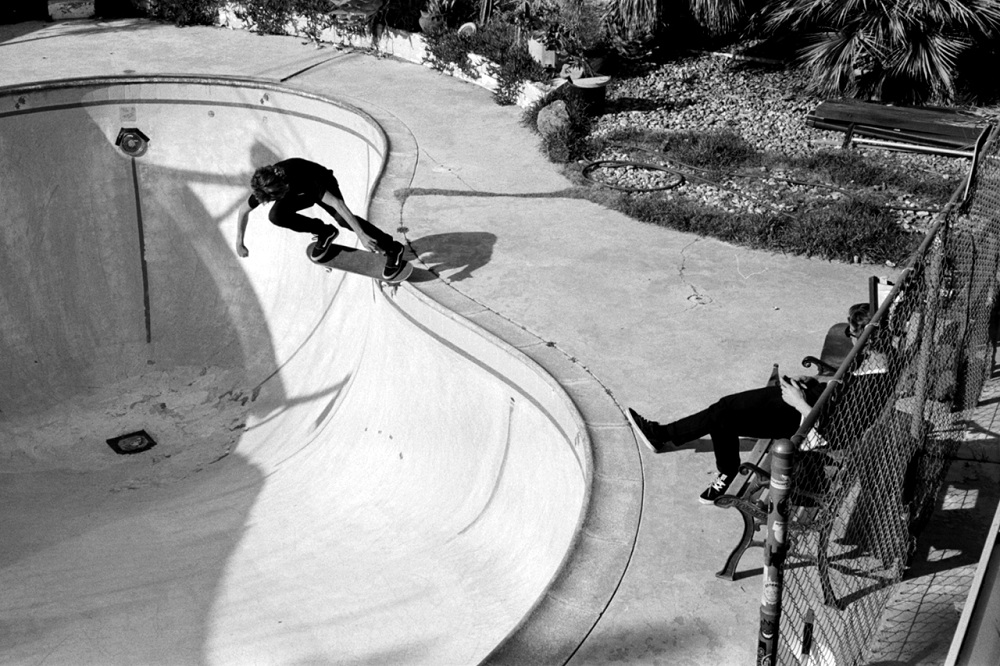
In this frame, the curve of the pool's edge, the skater's shadow, and the legs of the person watching from the bench sit in the same light. It reads less like an action shot that isolates the peak of a trick and more like a record of the whole moment in that place. The distance suggests that the photographer is one of the friends who were there.
At the end of the interview, asked for a favorite image or memory from using a Leica, he answered: "The next one I'll shoot."
The void after the body gave out
Here the story of the photographs pauses.
The text by Saari that SUPER LABO uses to introduce BIKE PATH begins: "After 20 years of skateboarding, my body was left broken." He could no longer physically ride a skateboard, and he had to face the questions of what came next and whether he would ever learn to live and love again. Photography helped bandage that void for some years. But only when he started surfing could he fully let go of the thought that he could not skate anymore.
After moving to Hawaii, he also went through a period of wondering whether he had lost his passion for making pictures. He calls it not a midlife crisis but "a mid-length crisis." Since a mid-length is a type of surfboard, it seems to be a joke from the years he was learning to surf.
This void matters for how the work is read. BIKE PATH is framed not as the result of a smoothly building photographic career, but as the record of someone who had nearly stopped shooting and found a reason again in his daily movement.
The North Shore bike path
What brought him back was the bike path.
Taking his kids to school, checking the surf, heading out to surf — he was on the North Shore bike path. He kept witnessing beautiful everyday moments there, and every time he saw a picture he kicked himself for not having his camera. Eventually he began with surf action, then with the daily lives of people coming and going in that water world. According to Pelago's blog, he started loading his camera gear on a bike and riding the local paths, and what he saw grew into a project of its own.
In his words: "My passion for photography has always consisted of landscape, portraits, and action. The North Shore bike path embodies all that for me."

The cover is a hand-lettered sign: "BANZAI PIPELINE," an arrow, "170m." A pointer to one of the world's best-known surf breaks stands there in strong sun and shadow, almost naive in its handwriting. Not the destination itself, but something on the way there. The cover captures the book's position well.
| Item | Details |
|---|---|
| Title | BIKE PATH |
| Publisher | SUPER LABO (Tokyo) |
| First release | 18 September 2024 at SUPER LABO STORE TOKYO (per Pelago's blog) |
| Current edition | 3rd edition (2026) |
| Specifications | 144 pages, 92 images, hardcover, color offset printing, 20.3 × 27.9 cm |
| ISBN | 978-4-911112-34-2 (3rd edition) |
| Price | ¥9,000 (SUPER LABO, checked 5 October 2026) |
In its announcement of a February 2025 book signing, Treehouse in Honolulu noted that the first edition had sold out and the second was on its way. At the very least, the book has reached enough readers to go into further printings.

In this spread, a jumper is silhouetted above the rocks from a low position just above the water. Between the rough texture of the rock and the soft grey of the sky floats a single small figure. As in the 2013 pool photograph, the action is the subject, but most of the frame belongs to the place.
The sample images on the product page are mostly black and white, while the specification reads "color offset." Printing monochrome plates with color inks is one way to extend tonality, but whether that is what this book does cannot be confirmed without seeing it. In a 2016 Hypebeast interview he said he shoots almost exclusively in black and white. Whether BIKE PATH was shot on film or digitally could not be confirmed from published material.
Back to Helsinki, 2001
In 2024 Saari returned to Finland to take part in Concrete Currents (18 May – 27 October) at the Alvar Aalto Museum in Jyväskylä. Pelago's blog relays the idea that the kidney-shaped pool Aalto built at Villa Mairea in 1938 influenced pool design in California and, through it, the history of pool skating. The blog itself qualifies this with "arguably," and it is treated here as one reading.
On the same trip he photographed Helsinki's bike paths. The project that began in Hawaii had become something he took with him wherever he travelled.
Then in June 2026 came FILM2000Z at Treehouse Analog Selects in Honolulu, running from 6 June to 2 July. It is a shop that deals in film cameras, film, and processing, showing photographs he made on film in the 2000s. In the show statement he writes that when he found a photo of himself and his friend Antton on a Helsinki bike path in the summer of 2001, something clicked. That image sent him digging through the crates, and the show is what came out.
A 2001 frame from a Helsinki bike path, and a book made on the North Shore bike path. In the show, that Finnish frame hangs under the title "HIKI Bikepath." How much of this was intended is not known. Still, two "bike paths" more than twenty years apart facing each other in one photographer's work is almost too neat to be chance.
The route as the unit of work
Here is an attempt to turn Saari's way of working into something readers can use.
As a skater, his unit of shooting was the spot. Hear of a good spot, go there, shoot there. In the 2013 interview he said that skateboarding takes you to new places — a fancy part of town one minute and somewhere very different the next — and that photography is similar: it gives you a purpose for being there.
With BIKE PATH, the unit became the daily route. Instead of searching for destinations, he passes the same path over and over. The changes in light, people, and waves at the same place become the substance of the work.
That shift translates into concrete conditions for anyone who photographs:
- Carrying a camera becomes the precondition. What he regretted on the bike path was not his skill or his gear's performance, but not having a camera with him. The advantage he named for the Leica in 2013 — something you can wear all day — matters even more when the subject is a route.
- The speed of movement decides what you can catch. Moving from spot to spot on a skateboard and riding the same path daily on a bicycle let you notice different things. A bicycle stops quickly and starts again. It covers more ground than walking and sees more detail than a car.
- Repetition turns a record into a body of work. A single frame from a road you passed once tends to stay a record. When you pass the same road for years, the photographs become a record of a life lived in that place.
Walking with a single lens is the subject of Practicing With Only a 50mm Lens, and how a small rangefinder works as a camera you wear is discussed in Is a Current Leica Worth Buying?. Saari's example is useful for linking both of those to a simple condition: passing the same way every day.
Who this work speaks to
Arto Saari's photographs are likely to speak to readers who:
- are more interested in photographing within daily movement than on special photo trips;
- learned, or want to learn, hands-on in the streets before mastering the technical side;
- want to see skateboarding and surf culture as a record from the inside rather than as material viewed from outside;
- have gone through a period of nearly stopping and are wondering how to find a reason to shoot again.
On the other hand, readers who want a rigorous concept or a strong social question from a photobook may find it thin. Judging from its introduction, BIKE PATH is a book shaped by life in one place and gratitude toward it. Whether that softness is a strength or a looseness is where opinions will split. And for readers who do not know his name, the skating biography can intrude too much on how the photographs are seen. If you want to look at the work alone, look at the pictures before reading the biography.
What remains unconfirmed
- The camera used for BIKE PATH, and whether it was shot on film or digitally, could not be confirmed from published sources.
- The intent behind printing monochrome plates in color offset, and the result, need to be checked in the physical book.
- His birth year and the 2001 Thrasher Skater of the Year title rest on Wikipedia and on Pelago's blog, which says he was "nominated." Thrasher's own records were not checked.
- Hawaii Public Radio's events listing gives the FILM2000Z opening reception as 7 July, while the organizer Treehouse's page says 7 June. This article follows the organizer's page.
If the book is seen in print or a record of the show appears, dated notes on paper and print will be added.
Sources
- Leica Camera Blog: Rolling Through the Shadows – Arto Saari (16 April 2013)
- SUPER LABO: BIKE PATH (3rd edition) / Arto Saari
- Treehouse Analog Selects: FILM2000Z by Arto Saari
- Treehouse Analog Selects: FILM2000Z by Arto Framed Print (print notes)
- Treehouse Analog Selects: Bike Path by Arto Saari Book Signing
- Pelago Bicycles: Bikepath Side Mission
- Hypebeast: Arto Saari on Breaking Boundaries and Transitioning from Skateboarding to Photography (2016)
- Wikipedia: Arto Saari
As another case of old negatives becoming an exhibition, this piece can be read alongside When the Photographer Is Gone, Who Finishes the Photographs? — Michio Hoshino's "NANOOK". With Hoshino, those left behind completed the film; with Saari, the photographer himself is re-selecting his own negatives more than twenty years later. Both turn old film into an exhibition, but who does the choosing changes what it means.