What the Name "PEN" Has Carried — Reading the September 9 Announcement Before the Specs
Addendum, September 11, 2026: a dated addendum has been added at the end of this article following the official announcement on September 9. The article below is left as it was written before it.
OM SYSTEM will announce something on September 9, 2026. So far, the only thing the company has made official is the date.
This article does not try to guess the contents. Before the announcement, with no product name, no specifications and no price, there is no equipment review to write. What can be examined instead is the fact that the company chose "sixty-seven years of lineage" as its way of trailing the product. What a teaser shows is an editorial decision. There is something readable there, ahead of the camera it is still hiding.
What this article assumes
I have not handled the new model. I could not have: it has not been announced as a product. What follows is an organization of the official material and reporting available as of September 4, 2026. It is not a review. Rumored specifications are treated as rumors.
The article turns on a single point. The name "PEN" has been given three different meanings so far. Knowing that history gives you a way to read whatever appears on September 9 with a measure other than the pixel count.
The order the teaser chose
According to DC Watch, the teaser video OM SYSTEM published on August 26, 2026 flashes through successive PEN models starting from the 1959 original, passes through the 2009 mirrorless "OLYMPUS PEN E-P1," and resolves into the silhouette of a new model. On screen: "2026" and "9 SEPTEMBER."

Two decisions are embedded in that sequence. One is starting at 1959. The other is routing the line of film cameras to the present by way of the E-P1. Making 2009 a deliberate waypoint amounts to saying: the PEN is the name of a film camera, but that name has already been moved to digital once before.
Meanwhile, the words OM SYSTEM has actually published are remarkably few. The European Virtual First Look Events page gives dates of September 9 to 14 and the line "Something new is coming. Join us live for the reveal!" No product name, no category, no price. Two things are settled: the date, and the decision to speak through lineage.
1959 — it began on the side that was told "that isn't a camera"
The first Olympus Pen appeared in October 1959. Olympus's product history page records that design began from the concept of "a camera to sell for 6,000 yen," that it was a half-frame camera using 35mm film, and that its D.Zuiko lens and portability made it useful even as a professional's second body.
What matters is that this did not get approved as a showcase of engineering. The lecture transcript by its designer, Maitani Yoshihisa, is unusually frank about the reception inside the company. Even after commercialization was decided, the plant manager said, "We're not making that toy." Sales said it would not sell because no market for half-frame cameras existed in Japan at the time. In the end the first Pen was built by an outside contractor rather than in-house.
Maitani called these the "technical wall" and the "conventional-wisdom wall." Try to build a cheap camera and the engineering falls short first. Clear the engineering, and you are stopped by the belief that the result is not a camera.
The transcript is equally concrete about what happened on the far side of that wall. About a month after launch, on his way to work, Maitani came across a mother photographing her small son with a Pen. At the time 98% of camera buyers were men; women were around 2%. From there he conceived a camera with "no difficult operations at all, just one button to press," and pushed it through with a prototype built overnight, even as the head of the sales division came to his desk in person to talk him out of it. That camera was the Pen EE.
In the lecture Maitani says that after the Pen EE went on sale, purchases by women jumped from 2% to 33%. He prefaces this with "according to the data," and I have not been able to trace the underlying survey. It is more accurate to read the figure as an indication of who was counted as a customer in a camera shop at the time than as a precise statistic.
So the achievement of the first PEN was not that it was small. It was shifting the definition of what makes something a camera, from the number of controls to the ease of carrying it. The name stood for that gamble, not for a format.
PEN is not another word for half-frame
This is where beginners get confused most often. Half-frame — splitting the frame in two — is drawing attention again through cameras like the PENTAX 17. But the digital PEN is not half-frame.
The official E-P1 press release of June 16, 2009 explains why the name was carried over:
Then it was half-frame; this time it is the Micro Four Thirds System standard. With a distinctive format and original mechanism that make a camera smaller and shooting easier, and a design of enduring appeal, we wanted more people to feel the pleasure of photography and of owning a camera — and so we gave this product the name "Olympus Pen."
(Translated here from the Japanese release; the linked page carries the original wording.)
What was inherited was not the frame size but the sentence structure: make it smaller, make it easy, get it to more people. Once the means was half-frame; in 2009 it was mirrorless construction. The same release says of the design that it "inherits the high quality and density that the Olympus Pen F of old gave off, while aiming at a design that conveys a state-of-the-art digital camera — not nostalgia."
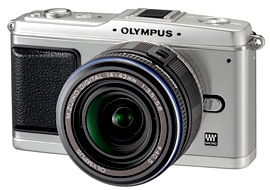
The same release puts cumulative worldwide sales of the film-era Pen at eight million units and calls the line a forerunner of the popularization of the camera. In 2009 Olympus revived a name and, in the same breath, pre-empted the suspicion that it was doing so out of nostalgia. Read now, that sentence is almost a forecast. Whoever brings a name back has to answer the same doubt.
2021, the third rewriting
After that, the name changed meaning once more.
The only model still listed as the current PEN lineup on OM SYSTEM's site is the OLYMPUS PEN E-P7, released June 25, 2021. Its product page says that "the PEN aesthetic, handed down through the years, lives here," and the related content beside it includes a feature on cameras that make a women's trip more fun.
If 1959 was about selling something people said was not a camera, and 2009 was about moving a philosophy of miniaturization onto a new standard, then by 2021 the PEN was a name for an aesthetic and a lifestyle. None of these is the correct one. The same three letters have simply been put to different work in different decades.
One further point can be verified from official naming. The E-P7 is still called "OLYMPUS PEN E-P7." The new OM SYSTEM brand was announced in October 2021, after the E-P7 had already shipped. Cameras since then lead with the company name — the OM SYSTEM OM-1, released March 18, 2022 — but the PEN line alone has not yet passed through that change of brand.
What has not been confirmed
As of September 4, 2026, all of the following are unsettled.
| Item | Status |
|---|---|
| Announcement date | September 9, 2026, confirmable on the official OM SYSTEM event page |
| Product name | Unannounced. Digicame-info, citing 43rumors, reports "OM PEN," but this is at the rumor stage |
| Viewfinder, weather sealing, front dial, vari-angle screen | All leaks. Not confirmable in official material |
| Sensor | Reported to be an existing 20-megapixel sensor; also unconfirmed |
| Price, availability | Not published at all |
There is one more thing I looked for while writing this and could not confirm. I could not find, anywhere in Olympus's own material, the explanation that the name "Pen" comes from the fountain pen. It is a widely repeated origin story, but the product history page and the E-P1 release say only that the name "was used for the half-frame camera released in October 1959." So this article rests on what the name did, not on where it came from.
Five questions for reading the announcement
Watching the stream on September 9, there are things to check outside the specification table.
- Where is the price positioned? The original started from a constraint: a camera to sell for 6,000 yen. Even the Pen S of June 1960 was 8,800 yen with case. The question is whether the sequence — fix the price first, then design — survives at all.
- Does OLYMPUS come off the name? If the rumored "OM PEN" is right, the PEN will leave the Olympus name for the first time in sixty-seven years. That is a question about how a lineage is handled, not a specification. When the brand was announced, OM Digital Solutions defined "OM" as "an attitude of always taking on difficult things and creating something new." If the two names stand together, they point at the same place Maitani called the conventional-wisdom wall. That kind of phrase is easy to put on a sign and hard to demonstrate in a product.
- Does it replace the E-P7 or sit beside it? In the lecture, Maitani says that normally a new model kills the old one, but "with the Pen, the old model never disappears when a new one arrives. Each model has its role." Consolidating into a single model would be a change in how the series is conceived.
- Whose photographs, and which sample images, are used to introduce it? What increased in 1959 was not image quality but the range of people taking pictures. Who is shown holding the camera at the announcement is the earliest clue as to who it is for.
- How is the existing Micro Four Thirds investment explained? What it means to own an interchangeable-lens standard is something I worked through in the piece on GoPro adopting MFT. Whether the story stays inside one body or is told at the level of a system changes who the audience is.
Who should wait, and who does not need to
If you do not own a camera yet, September 9 is worth watching — but watch the price, the weight and the scarcity of controls rather than the new features. If those inherit the logic of 1959, the lineage is doing real work. If they do not, the name is decoration.
If you already own Micro Four Thirds lenses, this is not about upgrading; it is about whether the system continues. The more lenses you have, the more the survival of the line matters relative to the performance of any single body.
If you are drawn to half-frame, waiting here will not give you what you want. Shooting on half a frame is a film question. I set out those criteria in the comparison of three film cameras you can still buy new. The name PEN and the half-frame format were separated in 2009.
If you already have gear you are satisfied with, there is no need to wait. The weeks before an announcement are when the mind moves most easily, but that is the kind of restlessness best handled as the "unsettled feeling" around upgrading.
One precedent about my own posture. I once read a registration filing for an unannounced camera as a specific model, and later had to correct that guess (why the compact camera's return cannot immediately be called a market recovery). Writing before an announcement, the harder you try to be right, the more you miss. So this article uses only the history of the name as its material.
What can be done after the 9th
Afterwards, the ordinary sequence returns. Check specifications and price on the official page, then handle the camera. In Tokyo, OM SYSTEM PLAZA (Estec Information Building B1F, 1-24-1 Nishi-Shinjuku, Shinjuku-ku; 10:00–18:00, closed Tuesdays and Wednesdays) lets you pick up mirrorless bodies and lenses. When a new product actually reaches the floor is worth checking in advance.
At that point it helps to return to the five questions. But the first thing a shop tells you is simpler than any of them. Hold it, and see whether you need a reason to put it in your bag tomorrow. What the 1959 Pen proved, reduced to its core, was only that. It is also what a teaser that runs sixty-seven years of lineage in a few seconds is really claiming — not a pixel count.
Everything up to this point was written before the September 9 announcement. The facts that became confirmable afterwards are gathered in the addendum below.
Addendum, September 11, 2026 — what the announcement settled, and what it did not
Everything below was added on September 11, 2026, after the official announcement on September 9. The article above is left exactly as it was written beforehand, so that what could and could not be said at the time stays visible next to what is confirmable now.
The name moved
The product is called OM SYSTEM PEN. The Japanese news release describes it as the first PEN series camera to carry the "OM SYSTEM" brand. It was announced on September 9, 2026, and is scheduled to go on sale in Japan in late October 2026.
That answers the second of the five questions above: whether the OLYMPUS name would come off. It did.
The move shows up in a single line of engraving on the front plate.


On the 1959 original, the front plate read "OLYMPUS-PEN": one hyphenated word. In the 2026 product image, the same position reads "OM SYSTEM," and "PEN" sits apart at the right edge of the body. What was one word is now two names placed side by side. That is closer to cohabitation than to inheritance.
As the article above notes, every PEN up to the E-P7 was an "OLYMPUS PEN." Roughly five years after the brand announcement of October 2021, the PEN line has finally passed through it.
Where the five questions stand now
| The question asked above | As of September 11, 2026 |
|---|---|
| 1. Where will the price sit? | The manufacturer lists an open price. DC Watch reports expected street prices of around ¥150,000 for the body, ¥165,000 for the lens kit and ¥175,000 for the double zoom kit |
| 2. Will OLYMPUS come off the name? | It did. The official name is "OM SYSTEM PEN" |
| 3. Replace the E-P7, or sit beside it? | Unconfirmed. The PEN product list showed both the PEN and the OLYMPUS PEN E-P7 on September 11, 2026, but I found no statement that the two will be sold in parallel |
| 4. Whose photographs will introduce it? | Travel and daily life. More on this below |
| 5. How will the existing Micro Four Thirds holdings be framed? | A lens kit and a double zoom kit are offered, and the specifications note that the splash-resistant performance applies "when combined with our splash-proof lenses." The camera is described with a lens, not on its own |
On the first question: the ¥6,000 constraint the original started from cannot be compared directly with these figures. The currency and the product category are both different. What could be compared is the order of decisions — but an open price says nothing about whether the price was fixed before the design began. All that can be said now is that this is not priced as an entry-level camera.
The photographer the manufacturer chose to show
The fourth question was whose photographs would introduce the camera. The official answer is travel and daily life.
The copy on the special site reads "PENと綴る、私の日々。" — writing my days with PEN. The two people who appear are AYUMI, who documents her travels, and the photographer Fuka Kamada. The product pages also carry a contribution by Mina Daimon. It is written from several months of use, but it is published on the product page: a manufacturer-hosted piece, not an independent review.
What sits at the centre of that piece is worth recording, because it is not performance. Daimon writes that what matters most is "whether I feel like taking it out," and locates the value in the reassurance of being able to release the shutter without hesitating at the moment you decide to shoot. She describes Profile Control as designing the colour itself before shooting, rather than after.
The article above argued that what grew in 1959 was not image quality but the range of people taking pictures. What the manufacturer put at the front in 2026 is not resolving power either; it is how often the camera leaves the house. At the level of rhetoric, the lineage holds. But this is a statement of intent, not evidence of a shooting experience. It tells you who the camera is aimed at, not whether it suits you.
An outside hands-on review looks at a different place
DPReview's hands-on review sees the same camera from another angle. Its reading: recommendable as a small travel camera with a viewfinder, but thin for anyone hoping for a PEN-F successor. It describes the back as cluttered, with six buttons plus a four-way controller, and points to friction in the way subject-recognition autofocus overrides the point you selected. It also notes that the viewfinder is the same roughly 2.36-million-dot unit as the PEN-F, a ten-year-old part.
That review, however, states that the body is available immediately at around $1,000. The Japanese official announcement gives late October as the on-sale date, and the two do not agree. Availability most likely differs by region, so for Japan the official Japanese wording is the one to go by.
A manufacturer-hosted contribution and an outside review are not a matter of one being false. They are looking at different places: the first at how often you carry the camera, the second at where the controls snag. And both are material to weigh before you check the camera yourself.
I have not handled the camera
To be explicit: at the time of this addendum I have not held an OM SYSTEM PEN. Everything above is an organization of published material and other people's reviews. It contains no first-hand account of handling or rendering. Numbers and other people's words cannot be assembled into the feel of a camera in your own hands.
Chances to handle it, from September 19
In Japan there are places to try the camera before it goes on sale. Both were checked on September 11, 2026.
- Shinjuku — OM SYSTEM PLAZA event space (Estec Information Building B1F, 1-24-1 Nishi-Shinjuku, Shinjuku, Tokyo), on Saturday September 19, Sunday September 20 and Monday September 21 (a public holiday). According to the announcement, staff talks run 11:00–11:45 and 14:00–14:45 each day, admission is free with no reservation, and a touch-and-try corner lets visitors handle the camera.
- Shibuya — the Tokyo Camera Club 2026 exhibition at Shibuya Hikarie 9F, Hikarie Hall A and B, from Saturday September 19 to Tuesday September 22. The announcement gives free admission with no reservation, 11:00–20:00 (until 17:00 on the first day and 18:30 on the last), and lists a touch-and-try of the OM SYSTEM PEN.
Dates, hours and contents can all change. Check each announcement again before going.
What to check when you do hold it is already written at the end of the article above. Pick it up and see whether you need a reason to put it in your bag tomorrow. No figure in the specification table answers that question directly. Not even the roughly 393g with battery and card, which says nothing about where the balance sits once a lens is attached.
Still unanswered
- Whether the E-P7 continues alongside it. Two entries in a product list are not an announcement of parallel sales. Store stock and the official store's listings are what to watch.
- The dust rating. The company writes "dust- and splash-resistant," but the only grade in the specification table is IPX1 on the splash side, noted as depending on a combination with the company's splash-proof lenses (checked September 11, 2026). If you expect rain or sand, check in a shop with the lens you actually intend to use.
- Whether price still comes before design. That order was the original's starting point, and the published material does not show whether it survives.
- Actual shooting. The Japanese release is late October. Anything hands-on comes after that.
One more thing this addendum does not do: it does not confuse the film-era PEN with the current camera. As set out in "PEN is not another word for half-frame" above, the 2026 PEN is a Micro Four Thirds camera with a 4/3-type sensor, and has nothing to do with half-frame.
Related reading
- What GoPro's adoption of MFT says about why small interchangeable-lens standards survive
- Why the compact camera's return cannot immediately be called a market recovery
- Lomo MC-A, PENTAX 17, Rollei 35AF — how three cameras use up the same roll
- The "unsettled feeling" around upgrading a digital camera
Primary sources and references
- Olympus: Olympus Pen (October 1959)
- Olympus: Olympus Pen S (June 1960)
- Olympus: Maitani Yoshihisa on the development of the Semi Olympus I through the Pen and Pen F series
- Olympus: launch of the "Olympus Pen E-P1" (June 16, 2009)
- OM SYSTEM: OLYMPUS PEN E-P7 basic information
- OM SYSTEM: Virtual First Look Events (September 9–14, 2026)
- OM SYSTEM: OM SYSTEM PLAZA, Tokyo
- OM Digital Solutions: announcement of the new "OM SYSTEM" brand (October 2021)
- DC Watch: a new PEN model may arrive in September; OM SYSTEM publishes a teaser video (August 26, 2026)
- Digicame-info: will the new OM SYSTEM camera be called "OM PEN"? (September 2, 2026)
Sources used in the September 11, 2026 addendum:
- OM SYSTEM: news release announcing the "OM SYSTEM PEN" (September 9, 2026, PDF)
- OM SYSTEM: OM SYSTEM PEN basic information / specifications / special site
- OM SYSTEM: PEN product list
- OM SYSTEM: contribution by Mina Daimon (manufacturer-hosted)
- DPReview: OM System PEN review
- OM SYSTEM PLAZA: OM SYSTEM PEN staff talk and hands-on event (September 19–21, 2026)
- OM SYSTEM: exhibiting at the Tokyo Camera Club 2026 exhibition (September 19–22, 2026)
- DC Watch: the "OM SYSTEM PEN," with an EVF and weather sealing (September 9, 2026)