Nikon's Microscopy Prize and the Landscape Before Ink Reaches Paper
When we look at a photographic print, we rarely think about the instant before ink reaches paper. An image that existed on a screen now exists on a sheet. Somewhere in that continuity, liquid crosses open air without being seen.
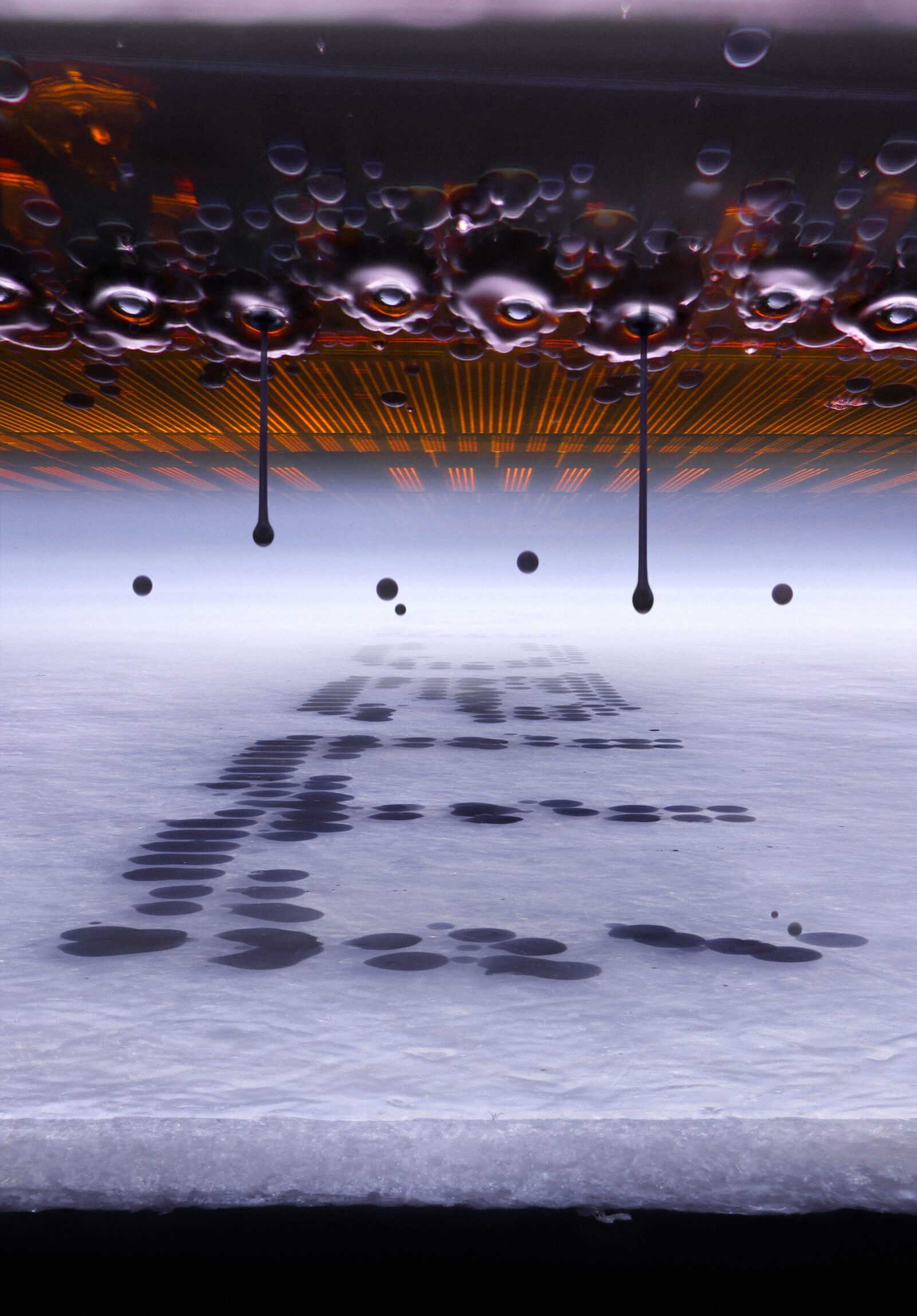
The winner of Nikon Small World 2026 photographed that interval. Ole Bielfeldt, based in Cologne, Germany, used a self-built rig and microscope objective to capture ink droplets inside an inkjet printer. Nikon announced the results on October 21, 2026; CNN.co.jp covered them on October 23.12
What interests me is more than the enlargement of something invisible to the naked eye. To make the photograph possible, he changed how the printer moved. Part of the photographic work took place outside the camera.
This essay draws on public materials and the entry information. I have neither examined the rig nor reproduced the photograph. It is not a camera review or a test of an ordinary printer's performance.
Before making the shutter faster, decide what to hold still
Nikon describes two initial problems. The moving printhead made a tiny area difficult to keep in focus, and the ink droplets moved too quickly for the camera's shutter to freeze.1
Bielfeldt modified the printer so that the head stayed still while the paper moved beneath it. Working in darkness, he used a brief flash to arrest the droplets.1
These are separate operations. Fixing the head keeps the intended subject in one place. Shortening the light freezes the droplets passing through it. Position and time are not being solved through one camera setting.
“I need a faster camera” directs a solution toward replacement. Asking what movement causes the problem, and for how long light is needed, reveals conditions that can be changed in the apparatus. Equipment still matters. The problem has first been made smaller.
This is not an untouched view into an ordinary running printer
The modified apparatus matters to how we read the image.
Observing a printing process and rearranging it for photography can coexist. Looking only at the final image, we might imagine that this composition waits intact inside a household printer. That misses an essential part of its making.
Science News's reporting with Bielfeldt includes photographs of the rig and printed paper. He repeatedly printed the word “macro.” We can follow the process beyond the airborne drops to what remained on the sheet.3
Photography here requires more than choosing a subject. Positioning light, clearing a background, changing what moves: making conditions for looking is part of making the photograph.
How faithfully the rig preserves the original printing motion, and how broadly it represents other printers, would require separate tests. One prize-winning image cannot establish the precision of an entire machine.
A printed photograph has a moment before landing
We normally inspect an inkjet print after the ink has landed. Are fine details intact? Do shadows break into steps? How do colors differ from the screen? We look at the completed surface.
The droplet photograph places our gaze immediately before that surface. A head above, paper below, droplets crossing the gap. The work of carrying an image acquires a visible distance.
Merely saying that digital images are material too would lose some of the specificity. Here, an image's arrival on paper passes through moving liquid. A file and a printed surface do not connect automatically as the same thing.
After this image, I would like to look closely at a print of my own: at what distance do ink dots and paper texture become a single picture? That would not reproduce Bielfeldt's photograph. It would be another way to look beyond the finished image. Changing where we begin does not require dismantling a machine.
“Real because unprocessed” is not enough
The official entry lists Slow-Motion and Image Stacking, and gives 20x as the microscope objective's magnification. That is not the final enlargement on a viewer's screen.4
Image stacking combines multiple images. The technique label alone does not establish how many were combined, in what order, or when each part was recorded. We should not invent an explanation of how moving droplets and stacking were reconciled.
Nikon's announcement describes Bielfeldt's commitment to photographing real subjects rather than generating images with AI. It also describes his use of focus stacking and image editing. This does not identify every operation performed on this particular winning image.1
The earlier article on the video competition's AI disqualification distinguished a ban from disclosure and checking originals. This still-image award is no reason to recast the result as a victory for untouched photography.
What was recorded through light, and how was it assembled into the final picture? More explanation can give us more to see. Knowing there was processing need not remove the surprise.
Rebuilding a tool to look inside it
The essay on microscopy entering a photography museum considered an image's movement into a space for contemplation. This photograph makes visible an earlier task: bringing a subject into a state in which an image can be made.
Choosing a subject and then choosing a camera is not the only sequence. When something will not photograph well, we can reconsider its movement and the duration of the light. A familiar tool may then become an unfamiliar landscape.
Learning from this does not require buying the same magnification. Separating a problem into focus, motion, and light is useful elsewhere. Precisely reproducing the winning image, however, would require capture details that remain unavailable.
Before an image settles on paper, droplets hang in air. To show that interval, he first made the printer move differently. My attention stays with that procedure as much as with the finished photograph.
Sources and unknowns
Checked October 24, 2026. The official gallery below shows the work. Full settings, stacking procedure, specific retouching, and camera model remain unverified.
Footnotes
-
Nikon Small World, 52nd Annual Nikon Small World Competition Winner, October 21, 2026. Results, production account, and the photographer's statements. An organizer's account, not an independent technical test. ↩ ↩2 ↩3 ↩4
-
CNN.co.jp, ニコン顕微鏡写真コンテスト、受賞作は「インクジェットプリンター内部の液滴」, October 23, 2026. Japanese reporting of the result and announcement date. ↩
-
Allie Skalnik, Peek into hidden worlds revealed by the 2026 Nikon Small World contest, Science News. Checked October 24, 2026. Reporting with the photographer, including photographs of the rig and printed paper. ↩
-
Nikon Small World, Microscopic view of an inkjet printer depositing ink onto paper. Title, photographer, placing, techniques, and objective magnification. ↩