Why Was a Winning Microscopy Video Disqualified? — What a "No AI-Generated Entries" Rule Could Not Decide
Fine hairs ripple across the surface of an airway. The vividly colored microscopy video was said to show tissue from a child with primary ciliary dyskinesia (PCD). In September 2026, it took first place in Nikon's microscopy video competition, Small World in Motion.
On October 9, Nikon withdrew that award. Its official statement said the video "did not comply with the competition rules regarding generative AI" and adjusted the rankings.
One could read this as a story about catching a cheat. This article looks elsewhere. The rules already said that AI-generated entries were not allowed. So why did it take criticism from outside scientists and a second review, after the award, to reach a decision? The question is what that single sentence decided, and what it left undecided.
Scope of this article
This article is based on public materials checked on October 12, 2026. The author is not a microscopy specialist and does not judge whether the video is biologically plausible. Nor does it assess the entrant's intent or honesty. Nikon's own statement says the decision concerns eligibility under the rules and should not be read as a judgment of the entrant's professional reputation, scientific contributions, or intent.
Most of the entrant's explanation and the scientists' criticism reached us through the press. The entrant's own post, the BBC and Nature articles, and the original open letter from researchers could not be checked. Below, what was confirmed in primary sources is kept separate from what was reported.
This also continues an earlier article on microscopy images entering a photography museum. There, I argued that whether a scientific image can serve as both evidence and expression depends not on whether it was processed, but on whether we can trace what was made visible and how. Here, the question is where that traceability was missing from the rules.
From award to disqualification
Laid out by date, the sequence of the decision becomes visible.
| Date | Event | Source |
|---|---|---|
| June 2–4, 2026 | Judging. The video winners were to be announced in September, the still-image winners in October | Nikon judging panel announcement (May 12) |
| Mid-September | Small World in Motion winners announced | PetaPixel (Sept 16, not read), Gizmodo |
| From mid-September | Researchers point out implausible morphology, including in comments on Nikon's LinkedIn post | Gizmodo (Oct 2), ABC (Oct 10) |
| Oct 1–2 | Nikon reported to be re-reviewing the entry | PetaPixel (Oct 1, not read), Gizmodo |
| Oct 9 | First place disqualified and rankings adjusted; Nikon says rules and evaluation procedures will be revisited | Nikon statement |
| As of Oct 12 | Still-image (Photomicrography Competition) results not yet announced | Nikon news page |
The new ranking in the statement is: 1st Nguyen Nam Nhat, 2nd Benedikt Pleyer, 3rd Dr. Andrew Moore, 4th Dr. Patrick Hickey, 5th Dr. Igor Adameyko. The new winner originally placed second.
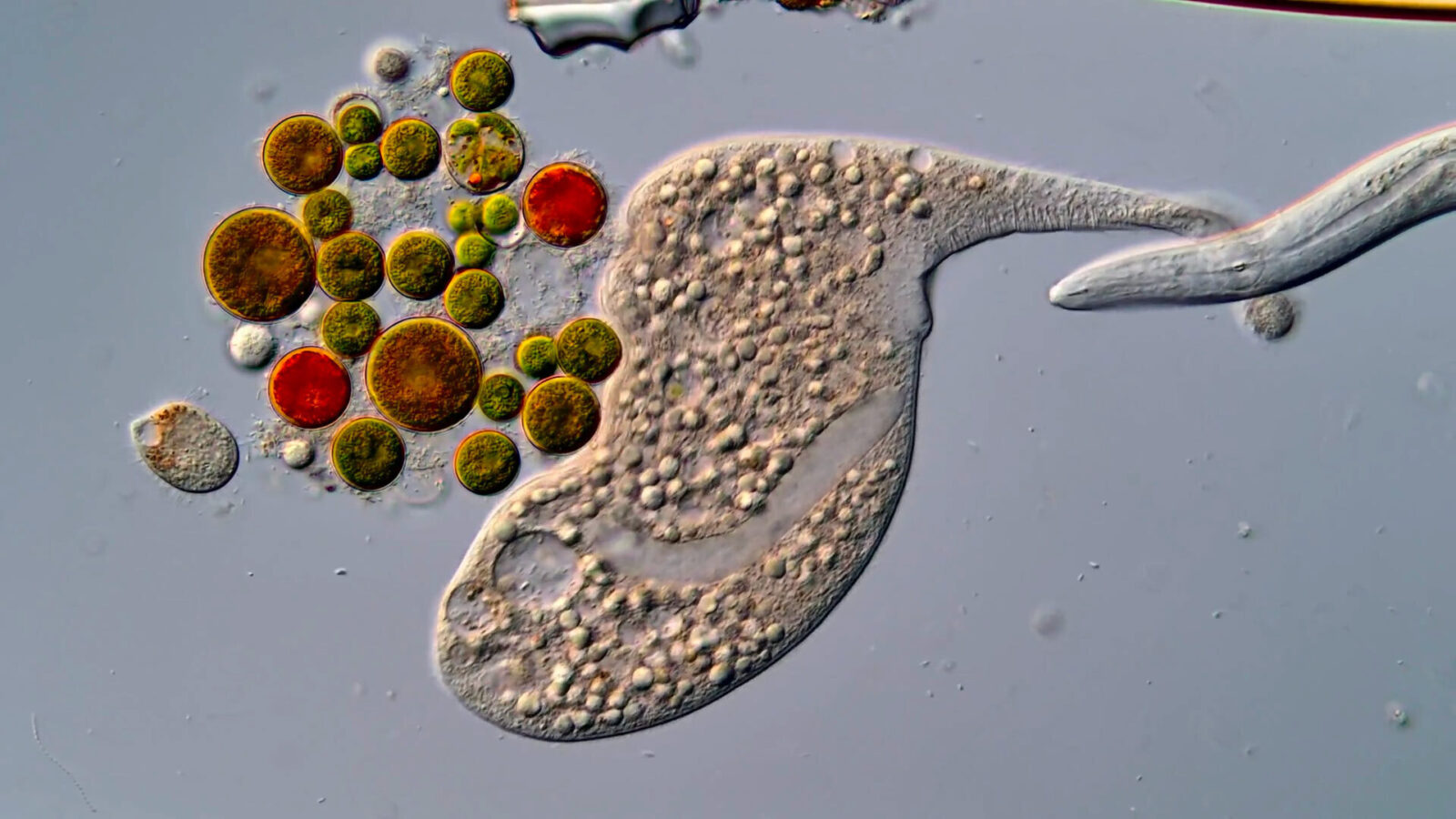
The statement does not name the original first-place entrant. Press reports attribute the video to Ning Xu, an optical engineer at the National University of Singapore.
Note that judging took place in June, and doubts surfaced only after the winners were announced. The statement does not say what was submitted or checked during judging. DPReview (Oct 10) also points out that the statement does not explain at which stage, or to what extent, AI was used.
What the rules said, and what they did not
The Small World in Motion rules now online are for the next round (entries from July 24, 2026 to April 30, 2027). The original 2026 rules could not be checked, so what follows applies to the current rules.
Two passages mention AI.
- Guidelines: "AI generated videos are not permitted and Sponsor holds the right to request the original video for verification."
- Section 5: "Submissions generated by AI, script, macro or other automated means are void."
The still-image rules contain the same two sentences, with "images" in place of "videos."
Neither set of rules, however, says what post-processing is allowed or must be disclosed: coloring, enhancement, denoising, combining focal planes. In July, the earlier article confirmed that the 2026 still-image rules required entrants to submit a description of the equipment and the image. That check did not record how processing was treated, and the 2026 video rules themselves have not been seen.
That is the difficulty here. Most microscopy videos become visible only after some processing. Signals are assigned colors, brightness is adjusted, data across time or depth is combined. Some of these methods use machine learning.
The rules draw no line between "generated by AI" and "processed with AI." A ban exists. But there is no measure for where generation begins, and no procedure to check it at the judging stage. All that remains is the sponsor's right to request the original video.
How much was "acknowledged" varies by outlet
Accounts of the entrant's explanation also vary.
Gizmodo (Oct 2), drawing partly on Nature's reporting, summarized it this way: the original cilia footage and its motion are real; AI was used only on reconstructed grayscale data to distinguish and color structures with similar morphology; no anatomical claims are made about the rendered features.
ABC (Oct 10) reported that the entrant said he rendered the regions below the cilia to improve presentation rather than to provide an anatomical reconstruction. DPReview wrote that, according to the BBC, the entrant "acknowledged using AI." The author could not read the BBC article itself.
Was it help with coloring, rendering of some regions, or AI use in general? What was "acknowledged" overlaps across outlets but is not identical. The entrant's own LinkedIn post could not be opened at the time of checking.
Gizmodo also reported that Nikon added a line to its blog post on the winning entry saying "an unsupervised neural-network method was subsequently used as part of the post-processing." The original text of that addition could not be verified.
This article therefore does not settle at which stage, or how far, AI was used. What is certain is that Nikon judged the video noncompliant with its generative AI rules, and that the statement does not explain the substance of that judgment.
What moved the line was the eye of outside researchers
What actually set the rule in motion was neither the judges nor automated detection. It was researchers looking at the winning video and pointing out problems with its morphology.
According to reports, Edward Phelps of the University of Florida wrote on LinkedIn that a mitochondria-like structure beneath the epithelium was biologically implausible and that particles resembling nuclei did not behave like nuclei. ABC also cited comments that the cilia appeared from nowhere and did not match their known size. Melanie White of the University of Queensland was reported as telling Nature that scientists need to be able to trust that what they see is grounded in the underlying measurement.
According to ABC, microscopy researchers wrote an open letter calling for outside examination of the winning work and for Nikon to enforce its own rules. The original letter could not be found.
On social media, there was also a claim that Google DeepMind's SynthID watermark had been detected in the video. It came via CNN's reporting, and no primary confirmation or independent verification could be found. Nikon's statement does not mention it. Here it is recorded only as an unverified claim.
What deserves attention is where the grounds for the decision came from. Before any mark left in a file, expert knowledge — "these cells do not behave this way" — found the problem. The correctness of a microscopy image is ultimately checked against knowledge of the subject. The research community acted as a verification system outside the image.
But this happened voluntarily, after the award. It was not built into the judging procedure. The rule came into force only after someone outside raised the issue.
A rule that asks for disclosure: the difference from JOICO
Even among microscopy image awards carrying the Nikon name, rules take more than one form.
The NIKON JOICO AWARD 2026 entry guidelines, run by Nikon Solutions in Japan, state that images processed or edited with software may be submitted. The FAQ asks entrants who submit edited images to describe the edits in the work information. No clause on generative AI, submission of original data, or verification could be found.
Adding RPS's International Photography Exhibition 167, covered in an earlier article, shows three ways of drawing the line.
| Item | Small World (current rules) | NIKON JOICO AWARD 2026 | RPS IPE 167 |
|---|---|---|---|
| Generative AI | Generated entries not permitted / void | Not mentioned | Excluded, wholly or partly |
| Image processing / editing | Not mentioned | Permitted | Manipulation with editing software allowed |
| Disclosure of processing | Not mentioned | Describe edits in the work information | Declare if authenticity is altered in documentary-type genres |
| Means of verification | Sponsor may request the original video or image | Research summary diagram and a published paper submitted as a set | Prints submitted at the final selection |
The RPS column is based on the entry FAQ checked on August 11, 2026. The three programs differ in purpose and scope; the table is not a ranking.
Small World's rules are a prohibition model: they put the ban first. They say what must not be used, but have no mechanism for asking entrants to explain what they did. JOICO is a disclosure model: it assumes processing and asks entrants to describe it. Because it does not name generative AI, it does not draw the boundary itself. But entrants have a place to explain their processing, and the paper and research summary show the image's scientific background.
Whether a disclosure model would have prevented this case is unknown. The guidelines do not include a procedure for checking whether the description is accurate. Still, if the coloring method and the rendered regions had been put into words at entry, judges could have compared that account with the images. It would have been harder for the boundary to stay invisible until someone outside pointed at it after the award.
For readers in Japan, the difference matters. JOICO AWARD 2026 is scheduled to notify winners in December 2026 and announce them in April 2027. Within the author's search, no official Japanese-language announcement about this case was found. The organizer of Small World is the U.S. company Nikon Instruments, which is separate from JOICO's operation. Two awards with the same name use different models of rules, and both entrants and viewers of winning images benefit from knowing that.
Not a signature or a watermark, but original data
Debates about authenticity in cameras often focus on capture-time signatures and digital watermarks. In the article on Canon's Authenticity Imaging System, I looked at who gets access first to systems that prove provenance from the moment of capture.
The microscopy video raised a slightly different question. Not a signature showing which camera recorded it, but the original data, the processing record, and whether what appears is biologically possible. It points in the same direction as the AMED image-processing guide mentioned in the earlier article, which asks researchers to keep original images and record processing steps.
A watermark can be a clue that generative AI was involved. Even when one is found, it does not tell us whether the AI helped with coloring or drew structures. And when none is found, that does not prove AI was not used. To decide the boundary of a scientific image, a record of what was processed, and in what order, is needed. What these rules lacked, I think, was a sentence asking for that record.
What the type of rule separates
A prohibition model makes the line look clear. It tells entrants not to use AI, and lets the organizer void an entry once a violation is found. But unless the boundary between generation and processing is defined, that line can only be drawn after the fact. As here, the decision moves only after a winning work is published and seen by experts.
A disclosure model assumes processing. It is closer to how research images are actually made and gives entrants a place to describe their workflow. But the line of what is forbidden becomes weaker, and without a procedure to check the description, disclosure stays self-reported.
Which model is preferable depends on what a competition wants to protect. Does it want to collect visual wonder widely, or to guarantee that images are grounded in measurement? If the latter matters most, a ban needs to be joined by disclosure of processing and a procedure for returning to original data at the judging stage. Nikon's statement about revisiting rules and evaluation procedures likely points to exactly this.
Viewers of winning images can do something too. Ask whether a color is the color seen during observation or one assigned to distinguish signals, and how much of the processing is explained. Beauty without explanation can still be seen as beauty, but it cannot yet be read as evidence.
What to check next
This article will be updated when any of the following appears.
- The still-image results. Scheduled for October 2026 and not announced as of October 12. They will be the first results after the disqualification; it is worth watching whether any explanation of judging or verification is added.
- Rule revisions. How the next rules define "generative AI," disclosure of processing, and submission of original data.
- A first-hand statement from the entrant. At which stage, and how far, AI was used — checking the differences among reports against his own words.
The original 2026 rules, the original text of Nikon's blog addition, and the researchers' open letter will also be reflected once they can be checked.
Related articles
- Where Does an Image Become a Photograph? — When Microscopy Enters a Photography Museum
- Generative AI Is Out, but Gold Leaf and Wet Plate Are In — Where RPS Draws Photography's Boundary
- To Those Who Can Prove It, First — The Line Canon's Authenticity Imaging System Draws
- iPhone's "No AI Editing" Proof: What a Digital Negative Preserves
Sources and verification
Checked on October 12, 2026 unless noted. Press content is treated as what each outlet reported.
- Nikon Small World: Nikon Small World in Motion Video Statement — October 9, 2026. The disqualification, the scope of the decision, the new ranking, and the plan to revisit rules and evaluation procedures.
- Nikon Small World: Small World in Motion Official Rules — Current rules (entries July 24, 2026 to April 30, 2027): AI clauses, Section 5, Section 6 license.
- Nikon Small World: Photomicrography Competition Official Rules — Current AI clauses for the still-image competition.
- Nikon Small World: Judging panel announcement — May 12, 2026. Judging dates and announcement schedule for each competition.
- Nikon Small World: News — Confirms the still-image results had not been announced.
- NIKON JOICO AWARD 2026 entry guidelines (Japanese) — Treatment of processing and editing, description of edits, and the notification and announcement schedule.
- RPS: IPE 167 Entry Guide and FAQs — Exclusion of generative AI and treatment of editing (checked August 11, 2026).
- AMED: Appropriate image processing methods (Japanese) — Keeping original images and recording processing steps.
- Gizmodo: Contest-Winning Microscope Video Is Full of AI Confabulations, Scientists Say — October 2, 2026. The entrant's explanation, scientists' criticism, the blog addition, and the SynthID claim (all via this article).
- ABC News: Winner of Nikon's Small World In Motion competition was AI generated — October 10, 2026. The entrant's explanation, scientists' criticism, and the open letter.
- DPReview: Generative AI scandal has come to one of Nikon's competitions — October 10, 2026. What the statement leaves unexplained and a summary of BBC reporting.