When the Photographer Is Gone, Who Finishes the Photographs? — Michio Hoshino's "NANOOK"
In August 1996, Michio Hoshino died suddenly on the Kamchatka Peninsula. He left behind exposed film — and one major subject never gathered into a photobook.
Twenty-six years later, in 2022, a panoramic camera was found at his home in Alaska. There was still film inside. Now, in the summer of 2026, thirty years after his death, work drawn from that film hangs among some ninety prints at FUJIFILM SQUARE in Roppongi, Tokyo, as "Michio Hoshino: NANOOK — A Quiet Story of the Ice Field."
You can read this as a retrospective with unseen work. But what deserves attention sits one step earlier in the process: when the photographer is gone, who selects the film, who prints it, and who completes it as a book?
Short answer
The person who pressed the shutter is no longer here. And yet the body of work is growing.
What is happening in this exhibition is posthumous editing: from an archive kept by the family, a production company shapes the sequence, and a professional lab decides color and tone for silver halide prints. Polar bears were the only major subject in Hoshino's work never made into a photobook — and the first one, Nanook: A Quiet Story of the Ice Field, was published alongside this show. The "completion" of the work is taking place thirty years after the exposures, through several pairs of hands.
Read as an exhibition where those hands are visible, this is not a memorial. It is a present-tense question about authorship in film photography.
Premise
The writer has not yet seen the exhibition in person. What follows is a pre-visit note based on the organizer's official announcements and public information, not an assessment of the prints or the installation. Where the decision process behind selection and printing is not public, I will keep fact and inference separate.
Exhibition basics
| Item | Details |
|---|---|
| Title | Michio Hoshino: NANOOK — A Quiet Story of the Ice Field |
| Venue | FUJIFILM SQUARE (Roppongi, Tokyo Midtown) |
| Dates | July 24 – August 13, 2026 (open daily, free admission) |
| Works | About 90 color prints (planned), silver halide, up to 1,000 × 3,000 mm |
| Materials | The Fujifilm Panorama G617 Professional camera itself; about 10 panels on wildlife and environment (planned) |
| Publication | First polar bear photobook, Nanook: A Quiet Story of the Ice Field (Crevis, 144 pages) |
| Tour | Fujifilm Photo Salon Osaka, July 16 – August 4, 2027 (planned) |
Fujifilm organizes, Crevis produces, and the Michio Hoshino Office cooperates. That arrangement is itself part of the answer to "who finishes it."
2022: a camera is found
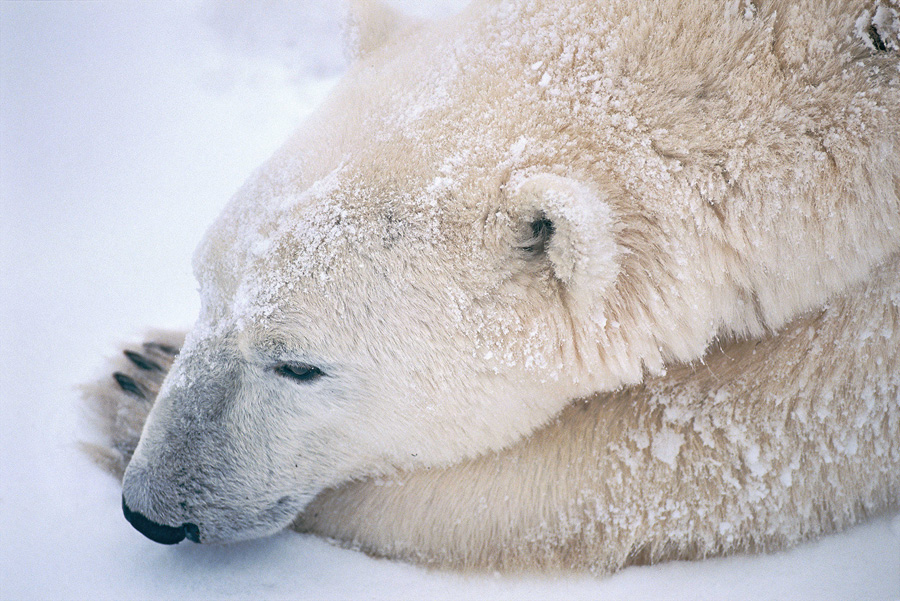
According to the official announcement, a panoramic camera was discovered at Hoshino's Alaska home in 2022, and work from the film left inside it is shown here for the first time. The camera itself — Fujifilm's Panorama G617 Professional — is on display.
Film inside a camera is a peculiar state for a photograph. The exposure is finished, but nothing has been developed or selected. Exposed, but not yet work. Had the photographer lived, he would have developed it, leaned over a lightbox, and decided which frames to keep. That entire stage was left suspended.
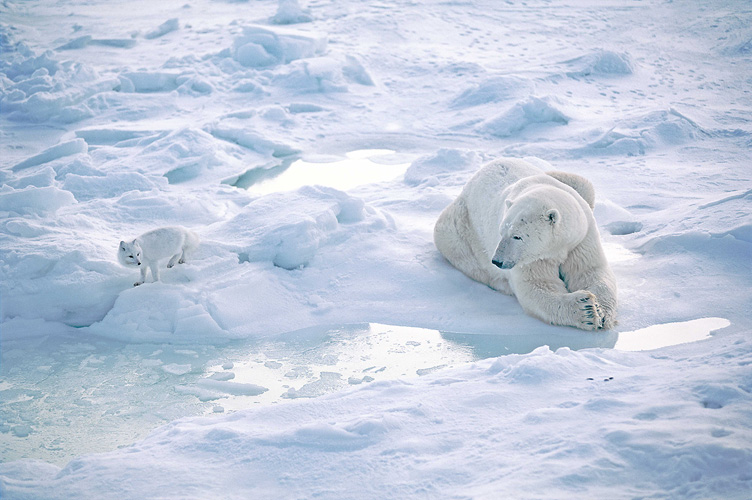
The decision to develop film that sat for twenty-six years. The decision about which frames can hold a wall. The decisions about color and density when enlarging to a one-by-three-meter silver halide print. None of these can be checked with Hoshino himself. And yet what hangs on the wall is "the work of Michio Hoshino." That distance is the most interesting thing about this show.
The hands of posthumous editing
From public information, at least three pairs of hands are visible.
The family — preservation and permission
Naoko Hoshino married Michio Hoshino in 1993 and accompanied him in the field. After his death, she founded the Michio Hoshino Office in 2000 and has managed the work ever since, moving between Japan and Alaska. The camera was "found" at the home — inside the family's sphere of care — and the first gate for any unpublished work opens here.
The printer — deciding color and tone
Among the exhibition talks is one featuring Masayuki Inaba of the professional lab Create, who entered photography out of admiration for Hoshino, speaking about how the prints for this show were made. That a printer's name appears in the organizer's announcement at all suggests the printing stage is being treated not as output but as judgment that completes the work.
Silver halide printing from film always involves interpretation — dodging, color balance, where the contrast sits. With no instructions left by the photographer, the color of Arctic light is decided by the printer, and by the memory of the family who saw the same light in the field.
The production company — shaping the sequence
Crevis, which produced the exhibition, is also the publisher of the accompanying photobook. Which of the ninety-odd images go in what order; what survives into 144 pages. A photobook is an edited object, and "Hoshino's first polar bear photobook" is, strictly, not a book Hoshino edited but a book edited from Hoshino's negatives.
Only when these three judgments stack up does "unpublished work" become "work." The photographer's eye is indispensable, but it is not sufficient — and this exhibition shows that structure with unusual frankness, perhaps without intending to.
The structural contrast with Maier
Posthumously discovered film calls Vivian Maier to mind. As noted in the piece on the Ginsberg–Maier centenary show, Maier's belongings were dispersed at auction, and editorial control effectively passed to strangers. The tension over who selects and who profits remains part of how her work is received.
Hoshino's case is the opposite. He was famous in his lifetime; his family founded an office and has managed the archive for nearly thirty years; and Fujifilm, his major publishing partner in life, organizes the show. There was a discovery, but no dispersal. The legitimacy of the editing rests on an extension of the relationships Hoshino built while alive.
Neither model is simply better. But the contrast makes two things visible: how much of a posthumous archive's fate is decided by whose hands it falls into, and how family stewardship functions as an established pattern in Japanese photography. Someday, someone may print your negatives — for anyone shooting film, this structure is not someone else's problem.
What to check in the gallery
- How the captions distinguish work from the film found in 2022. If it hangs mixed with work published in his lifetime, that choice is itself a statement of editorial policy.
- How the G617's panoramic aspect ratio changes the relationship between polar bear and ice field, compared with the standard-format prints.
- How the highlights in ice and snow are placed in the large silver halide prints — this is where the printer's interpretation shows most.
- If possible, the August 9 talk with Naoko Hoshino and Masayuki Inaba (reservation required), where the selection and printing decisions may be discussed. Most of this article's open questions can only be answered there.
- The differences in sequencing between the photobook Nanook and the exhibition — two stories edited from the same negatives, one for a wall, one for pages.
What remains unconfirmed
The selection criteria for unpublished work, what fraction of the recovered film was used, and who made the final call on print color are not visible in public information. This article does not fill those gaps with guesses; it is a map to be checked against the venue and the talks. If a visit changes the picture, an update will be added.
Sources and references
- FUJIFILM SQUARE: Michio Hoshino — NANOOK, A Quiet Story of the Ice Field (official exhibition page, Japanese)
- Fujifilm press release via PR TIMES: exhibition and event details (Japanese)
- Michio Hoshino Office
For a contrasting case of a posthumously discovered archive, A Poet and a Photographer Reunited at 100 — Ginsberg and Maier's "Notes from the Margins" widens the same question: who finishes the photographs?