A Photograph Is Not Finished When It Is Taken — How Viewers Remake an Image in Miyota
Suppose I look at a photograph and first decide that it is a family portrait. Someone beside me points to the space between two people. When I look again, I begin to notice a chair that had seemed like background and feet turned toward the edge of the frame.
The photograph has not changed. My attention has.
The theme of Asama International Photo Festival 2026 PHOTO MIYOTA is “After the Image.” On August 9 and 16, the program includes “Art Dialogue,” a session in which visitors reconsider photographs while listening to other ways of seeing. Here, a viewer’s words are not merely a response outside the photograph. They become part of the image’s later life.
Scope of this article
I have not visited the festival or taken part in the August 9 session. As of August 11, no participant transcript or report was available on the official site. This is a pre-visit note: a way to decide what to observe on site, including at the August 16 session, if the festival’s theme is to be tested rather than simply repeated.
I do not assume which works will be discussed or what anyone will say. The starting points are the published theme, exhibited works, and stated method of facilitation.
The festival at a glance
| Item | Details |
|---|---|
| Dates | August 1–September 27, 2026; closed Tuesdays, except August 11 and September 22 |
| Hours | 10:00 a.m.–5:00 p.m.; last admission 4:30 p.m. |
| Main venue | MMoP, Miyota, Kitasaku District, Nagano |
| Satellite venues | Miyota Town Hall, Ecole Miyota, Gokalab, and Nishi-Karuizawa No. 2 Community Center |
| Ticket | ¥1,500, reusable throughout the festival; some areas free |
| Dialogical viewing | August 9 and 16, 2:00–3:00 p.m. |
Miyota’s June 2026 Yamayuri newsletter confirms the dates, hours, MMoP and satellite venues, and the mix of paid and free areas. Extending the exhibition through the town also suits a theme that refuses to finish photography inside a white-walled gallery. If a visitor notices a related shape or light while walking after seeing a work, that too becomes part of the image’s “after.”
What happens after exposure
The official theme text says that photographs change meaning as they are seen, shared, remembered, forgotten, and sometimes misread. In a digital environment, reproduction, cropping, and relocation have accelerated, unsettling the borders between original and copy, fact and fiction.
The claim is not left abstract. Several exhibited works make those changes comparable.
Walker Evans’s Photographs for the Farm Security Administration recorded rural life in the 1930s as part of a government project. Almost ninety years later, the images are seen not only as policy documents but as works in the history of photography and memories of vanished lives. The images remain; their institutions and historical viewers have changed.

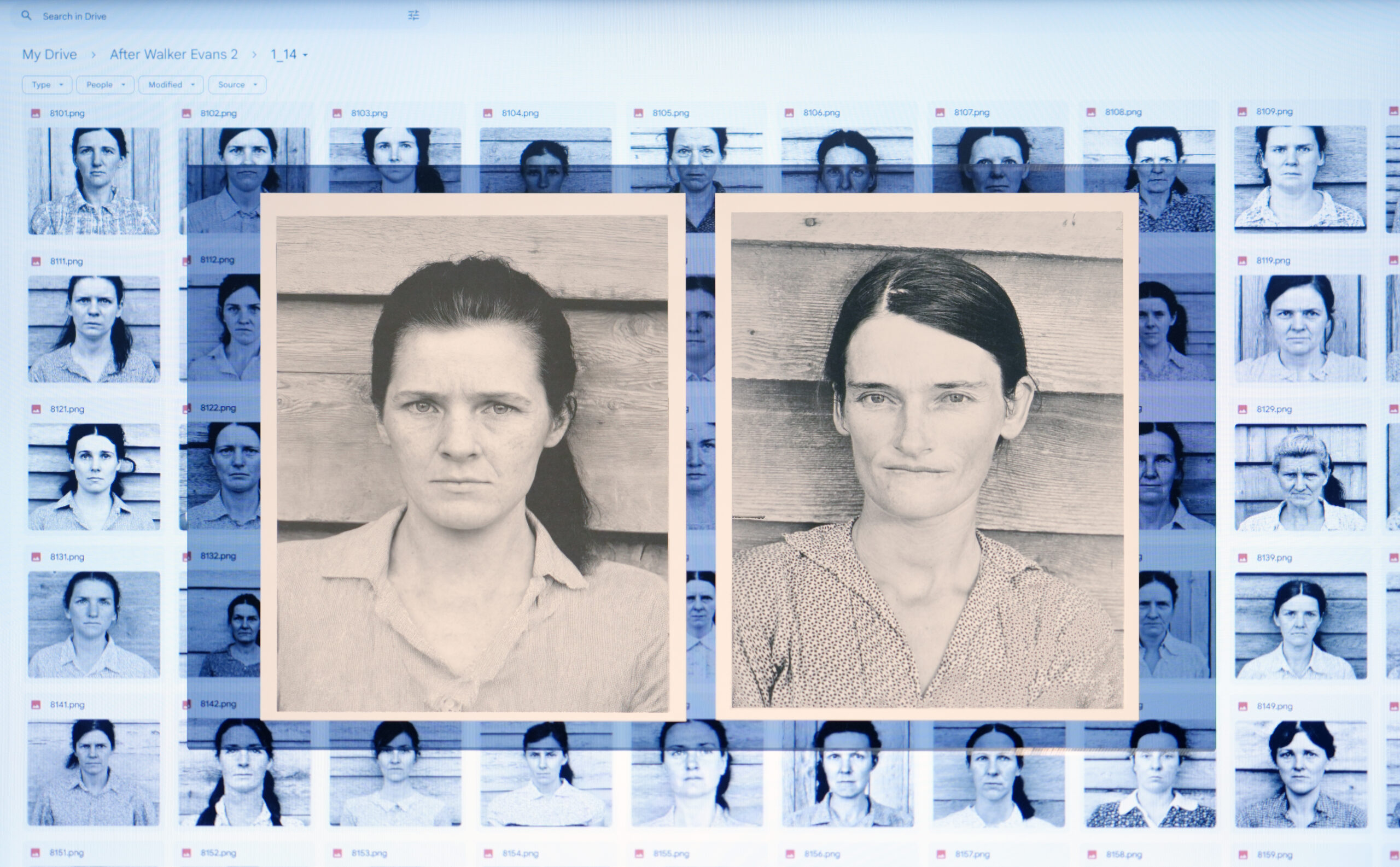
Aphic’s After Walker Evans 2 places an Evans photograph on the right and a similar image made with Stable Diffusion on the left. According to the official description, Aphic selected it from more than ten thousand generated images. The work layers three moments, each 43 years apart: the original photograph, Sherrie Levine’s rephotography, and AI generation.
ARCHIVES’ Vanitas🥺 is fictional throughout: fruit, a game console, a tablet, and logos that almost seem readable were all made with generative AI. The festival does not place it outside photography, but inside an exhibition asking what photography has become.

These three examples already show that “not finished when taken” has more than one meaning. A documentary photograph becomes a historical document and an artwork. Another artist rephotographs it, then AI makes a resemblance. A viewer revises a first impression after learning which image came from a camera.
What part of the image does dialogue change?
The August 16 Art Dialogue is based on Visual Thinking Strategies (VTS), a method used in art education. The official notice describes putting responses into words before a work, listening to other perspectives, and opening a photograph from each viewer’s present moment.
The dialogue does not alter the image data. It changes where we look, what evidence we use, and which memories we bring to it.
If someone notices a small scratch, a viewer who had watched only the subject may begin to see the support. If one person reads a family portrait and another senses a staged pose, the same gesture can appear intimate or tense. No correct answer is chosen by majority vote. Instead, more paths appear between observation and interpretation.
“An image remade by viewers” does not mean that viewers become its photographers. Its author and origin do not change. What viewers make is a set of relations the photograph carries for them, and a new entrance for the next viewing.
Four fields to record on site
To track a change before and after dialogue, it is more useful to separate four fields than to compress everything into one paragraph of impressions.
| Field | What to write |
|---|---|
| What I first saw | A person, colour, scratch, distance, or other concrete detail noticed before reading an explanation |
| Another person’s words | An observation I had not made, recorded without changing its meaning |
| What changed when I looked again | Where the image appeared different after hearing those words |
| What remained unresolved | A reading I could not accept, an unverified fact, or something not yet expressible |
For After Walker Evans 2, first note which side seemed photographic. After learning about the AI, record whether skin, clothing, background, or gaze became evidence for distinguishing them. Did someone else’s comment change that evidence? What unease remained? The history of a judgment moving is more useful later than whether it happened to be correct.
Photographers can return this record to their own practice. What did someone else notice first in my photograph? Did they read the background before the intended subject? Did a caption immediately narrow the image? Viewers’ words need not serve as praise; they can show how much another interpretation the frame can hold.
Dialogue does not always enrich a photograph
More voices do not automatically make a viewing deeper.
If a confident explanation arrives early, later comments may align around it. Reading the title or caption first can turn looking into an exercise in confirming text. A strongly projected personal memory can leave behind the people depicted and the historical conditions of the work.
Nor are all misreadings equivalent. A free association should be distinguished from getting an artist or date wrong. What an image evokes can remain open; its process and historical background still require sources.
This is why the fourth field—what remained unresolved—matters. The aim need not be agreement. We can carry away what another reading did not dissolve. Meaning can be revised without every meaning becoming equally valid.
What to test on August 16
The next Art Dialogue is scheduled for August 16, 2026, from 2:00 to 3:00 p.m. Participation details may change, so the official event page should be checked before departure.
On site, I would record not only which works were discussed but the order of facilitation. When is contextual information introduced? How long is silence allowed? Does the facilitator prevent the same people from filling the conversation? When someone interprets a work, are they asked where in the image they found their evidence? The quality of dialogical viewing may appear less in the number of comments than in whether words can be returned to the visible image.
For the August 9 session, public information confirms only that it took place. Which works were used and how participants’ attention changed should remain unwritten until a record is published or someone who attended can be interviewed. That absence becomes a question to carry into observation of the same format on August 16.
An exhibition’s boundary also changes an image
At the same time, RPS International Photography Exhibition 167 excluded work using generative AI in whole or in part. As discussed in the article on the RPS rules, AI images are separated from photography at the entrance to that open call.
In Miyota, the wholly generated Vanitas🥺 and the Evans-like images of After Walker Evans 2 appear inside a photography festival. In the same year, one institution uses the boundary as a rule; another shows it as a work.
Knowing the difference changes the exhibition again. Viewers’ words are not the only forces that make an image’s “after.” Which institution names it, where it places it, and beside which works also change what it can mean.
For someone who wants to receive a photograph quietly and close to its maker’s intention, dialogue may feel like surplus noise. There is value in protecting a first way of seeing. For those who consider what happens after an image passes to other people part of the work’s duration, Miyota offers a chance to test the theme with their own attention.
A photograph comes into the world as an object when it is made. What kind of picture it remains, however, continues to move. On August 16, the question is not whose interpretation was right. It is where one’s eyes moved before and after a single sentence.
Sources
- Asama International Photo Festival 2026 PHOTO MIYOTA official site — dates, venues, theme, exhibited works, and August 9 and 16 dialogical viewing sessions, checked August 11, 2026.
- Art Dialogue: Opening Photography’s “After” Through Dialogical Viewing — time and purpose of the August 16 session, checked August 11, 2026.
- Aphic: After Walker Evans 2 — the sequence connecting Walker Evans, Sherrie Levine, and Stable Diffusion, checked August 11, 2026.
- ARCHIVES: Vanitas🥺 — confirmation that every element was made with generative AI, checked August 11, 2026.
- Walker Evans: Photographs for the Farm Security Administration — the FSA context and later reinterpretation, checked August 11, 2026.
- Miyota, Yamayuri, June 2026 — theme, dates, hours, venues, and paid areas, checked August 11, 2026.
- IMA ONLINE: Open call for Asama International Photo Festival 2026 PHOTO MIYOTA through IMA next — the festival’s 2018 beginning, expansion through the town, and 2026 theme, checked August 11, 2026.