"Twilight and Evening Bell" — The Axis Joining These Three Is Not a Shared City but Where Each Draws the Line
Facing a three-person show, the reflex is to look for what the artists share. Two of them have photographed Shinjuku. So go and look at how their records of one city overlap and diverge — that is where I started.
Then I read the official statement. It describes "three viewpoints photographed in different places, by different methods, with different feelings." A shared city is not the axis of this show.
The short answer
"Twilight and Evening Bell" is not a show that compares three people who photographed the same subject.
The axis is where each of them drew a boundary, and which side of that line they shot from.
And the word "boundary" was not chosen in advance as an abstraction. It comes from the way one man — Gonta, a person Yang Seung-Woo photographed — divided the world. That is the most interesting thing about this show, and the thing most worth going to verify.
What this article is
I have not seen the exhibition. This is a pre-visit note, written on 15 August 2026, before the opening, using only what Zen Foto Gallery has published.
So I make no judgment about the quality of the work or the success of the hang. What I can offer is the structure readable in the published text and images, and the list of things I intend to check in the room. I have never seen original prints by any of the three side by side.
The facts first
| Item | Detail |
|---|---|
| Exhibition | Yang Seung-Woo, Haruto Hoshi, Brian Sergio, "Twilight and Evening Bell" |
| Venue | Zen Foto Gallery (Piramide Building 208, 6-6-9 Roppongi, Minato-ku, Tokyo) |
| Dates | 21 August (Fri) – 26 September (Sat), 2026 |
| Hours | Tuesday–Saturday, 12:00–19:00; closed Sunday, Monday, and public holidays |
| Extra closures | Closed 22 September (Tue) and 23 September (Wed) for public holidays |
| Talk | 19 September (Sat), 17:00–18:00, with Yang, Hoshi, Sergio and Mark Pearson; free, no booking |
| Reception | 19 September (Sat), 18:00–19:00 |
| Books published alongside | Yang Seung-Woo, You're there and I'm here (complete edition); Haruto Hoshi, Tokyo Trippy; Brian Sergio, Lost and Found |
The run is about five weeks. But two holiday closures fall in the second half, and the talk is late in the run, on 19 September. If you want the talk and the show in one visit, Saturday 19 September is the only date — and it will be busy. If you want a quiet wall, choose another day. Decide which of the two you want before you go.
This is not a show about one shared city
Line up the three photographers' locations from published sources and the overlap is smaller than expected.
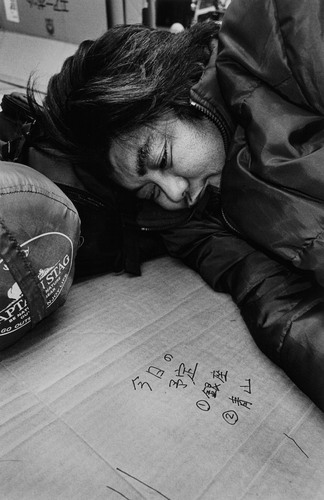
- Yang Seung-Woo: began photographing in Kabukicho in the summer of 1998, sleeping there on flattened cardboard. He is also the photographer whose book Shinjuku Lost Child (published 2016), made among people who called Kabukicho home, received the 36th Ken Domon Award the following year. The new book gathers more than twenty years with Gonta, the man he met there, into a single complete edition.
- Haruto Hoshi: has photographed Tokyo nights centred on Shinjuku, but his current shooting grounds are given as Roppongi, Yokohama, and Nishinari in Osaka. What he shows here is not the Shinjuku-centred Shinjuku 1999–2008 but Tokyo Trippy, built mainly from work made since 2014.
- Brian Sergio: lives and works in Manila. Lost and Found grew out of a photographic diary kept from the pandemic years onward.
So the reading of "two photographers of the same Shinjuku, plus one outsider" does not hold, at least not for the work on show. It would have held if Hoshi were showing his Shinjuku monochromes. He is showing colour instead.
One smaller thing is worth noting. Roppongi is among Hoshi's current shooting grounds, and the gallery is in Roppongi. For at least one of the three, this show sits inside his own working territory. Whether that changes anything on the wall I cannot say, but a street photographer exhibiting in a street he currently works is worth registering.
Where the word "boundary" came from
The statement pairs three sets of opposites, in the same order as the artists are introduced, so the mapping is easy to read.
| Paired opposites | The artist it appears to describe | What the published material says |
|---|---|---|
| Life and death | Yang Seung-Woo | The death of his friend Gonta, and the regret left behind |
| Reality and illusion | Haruto Hoshi | Drifting through the city's chaos to escape his own powerlessness and emptiness |
| Loss and return | Brian Sergio | From loss and isolation back, through a photographic diary, to a spiritual home |
The statement then closes on photography's power to connect "over there" and "over here."
What matters is that this vocabulary has a traceable source. According to the book description, Gonta's world was split in two: whether or not you had somewhere to return to. That alone made you "over there" or "over here." Yang's book takes those words for its title.
So the frame of this show is not an abstraction handed down by a curator. It borrows one homeless man's extremely concrete way of dividing the world. The abstraction did not come first and collect examples; the concrete came first and was widened to cover three people. That order matters when you read the show.
But anything widened is also thinned. In Yang's title the phrase appears in one orthography; in the statement it shifts to another. I cannot claim the difference is deliberate. What is certain is that a specific, urgent line — do you have somewhere to return to — has been moved into a metaphor shared by three photographers. That is the design of the show and also its risk. In the gallery I do not want to hold that against it; I want to see how much of the concrete survives.
Two of the three are going colour at the same time
There is a coincidence here that matters practically to anyone who photographs. Two of the three books are turning points into colour.
- Haruto Hoshi, Tokyo Trippy: his first colour photobook in eight years, since Whistle (2017).
- Brian Sergio, Lost and Found: his first colour photobook.
Yang's contribution, by contrast, is a complete edition built on Kabukicho monochrome. And Hoshi's Shinjuku 1999–2008 (2024) is explicitly described as a re-edit made by going back through monochrome negatives. So the show places two photographers' colour nights on top of a monochrome lineage.
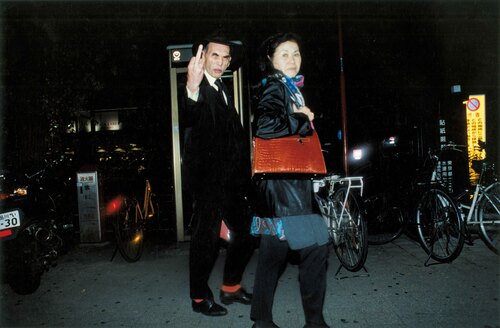
Twilight and neon are awkward hours for colour. Around sunset the colour temperature moves quickly, and a night street mixes fluorescent, LED, signage, and flash, so no single frame has light sources that agree. Low light means long exposures, and on film, reciprocity failure adds its own shift. This is the harshest edge of the point made in When Golden Hour Actually Works: low light gives you shape, not colour accuracy.
Which means a decision always shows on the print — do you suppress the disagreement, or leave it as the actual state of the street? Hoshi's afterword line about passers-by "switching on and off like neon" reads, at least on the page, like the second choice. Whether the images do the same is something you can judge yourself, standing in front of the prints with the colour-temperature, saturation, and area framework from What Colour Decides in a Photograph.
One limit: what any of the three shot on, and how they printed, is not stated publicly. Hoshi's earlier book is described in terms of negatives, so that one is film; the capture media for Tokyo Trippy and Lost and Found are not given. Grain, highlight roll-off, and shadow density in the prints will give you hints, but hints only. If you want certainty, the 19 September talk is the shortest route.
What I intend to check in the room
Here is what published information cannot settle. This is not a disclaimer; it is a list of decisions made before walking in.
- How the wall is divided. Equal thirds, or one artist as the centre of gravity? The key visual comes from Yang's line of work, which suggests he carries weight, but wall area is the only real evidence.
- How monochrome and colour are hung. Separate rooms, or mixed? If mixed, does the sequence itself enact the theme of the boundary?
- How specific the captions are. Are year and place given per image? If not, viewers will absorb three photographers as one undifferentiated night. Is that intention or by-product?
- Where Yang's complete edition ends. Gonta's death is explicit in the book. How the exhibition handles it is exactly the question of distance between a private record and a public work.
- The tonality of the prints. Grain, black density, highlight retention. A photobook cannot answer this.
Points 3 and 4 also test the viewer. There remains the question of how to keep from consuming someone's displayed life as an illustration of a theme.
If you are going
- The show runs 21 August (Fri) to 26 September (Sat), 2026.
- Open Tuesday to Saturday, 12:00–19:00; closed Sunday, Monday, and public holidays, plus 22 and 23 September. In practice Saturday is the only non-working day available.
- The gallery is in Piramide Building room 208, from Exit 3 at Roppongi Station (Toei Oedo and Hibiya lines). Other galleries share the building, so you can see several in one trip.
- The talk is 19 September (Sat), 17:00–18:00, free and without booking, with all three artists and gallery director Mark Pearson.
- Dates and hours can change. Reconfirm on the official page before travelling.
Who this show works for, and under what conditions
There is no winner to declare here, so let me separate the reasons for going instead.
Worth the trip if
- You photograph streets and want language for the distance you keep from your subjects. This show should give you three versions of that distance under one word.
- You are unsure how to handle colour at night. It is rare to see a monochrome lineage and a colour practice hung in the same room.
- You come to photography through books. Three titles arrive at once, so you can move between wall and page.
No hurry if
- You want a record of Shinjuku as a place. Given what is on show, that expectation will probably go unmet. Read Shinjuku 1999–2008 first if Hoshi's Shinjuku is what you want.
- You want technical or equipment information. It is not part of the published framing, and the show leans toward what is inside the photographers.
Fine to wait if
- The run is five weeks. Waiting for the 19 September talk, hearing the artists themselves, then deciding which book to buy is a perfectly reasonable order.
If this article sends you to Roppongi, do not go looking for what the three have in common. That is written in the statement already — and it is borrowed. What is worth watching is how far apart the three lines stayed inside a borrowed frame. Reading an exhibition as an editing structure rather than as news is something I also tried with Tokyo's "A Miraculous Gaze". On reading street photography itself, How to Read Daido Moriyama is the closest neighbour.
Sources
All checked on 15 August 2026.
- Zen Foto Gallery, "Twilight and Evening Bell" (dates, closures, talk, statement, the three books, artist biographies)
- Zen Foto Gallery information page (address, hours, access)
- Haruto Hoshi, Tokyo Trippy (publication year, format, afterword quotation)
- Haruto Hoshi, Shinjuku 1999–2008 (the re-edit from monochrome negatives)
- Ken Domon Museum of Photography, announcement of the 36th Ken Domon Award (Yang Seung-Woo, Shinjuku Lost Child; published 2016, announced 2017)